
This article is part of my MRI series. See Nuclear this Magnetic that - MRI series.
The nuclei of a certain type in our own body, when put in a very strong magnetic field, resonates when the machine sends a radio frequency wave. Subsequently, the machine detects the signal coming from these nuclei which then form images. Nuclear magnetic resonance imaging.
Do MRIs produce the ‘best’ medical images?
MRI is usually quite far down the list of imaging techniques in routine clinical care. The reason is many fold, but it contributes to the impression that MRI is the ‘best’ kind of imaging that produces the ‘clearest’ images.
Instead of too much physics, I will introduce what ‘clear’ means in the context of medical imaging. Then I will show the differences between MRI and other imaging modalities. These will hopefully provide a better understanding of why doctors are prescribing an MRI scan.
What doctors need to see from images
When we talk about a ‘clean’ or ‘good’ image, the first criteria that come into mind would be the resolution and sharpness. While they are important, for doctors, a sharp image is not enough. What they absolutely need from images is the suitable contrast.
The contrast here is not about how different the brights and darks are as they appear on screen (like in photo editing), but more to do with how well different tissues and structures can be differentiated as the brights and darks.
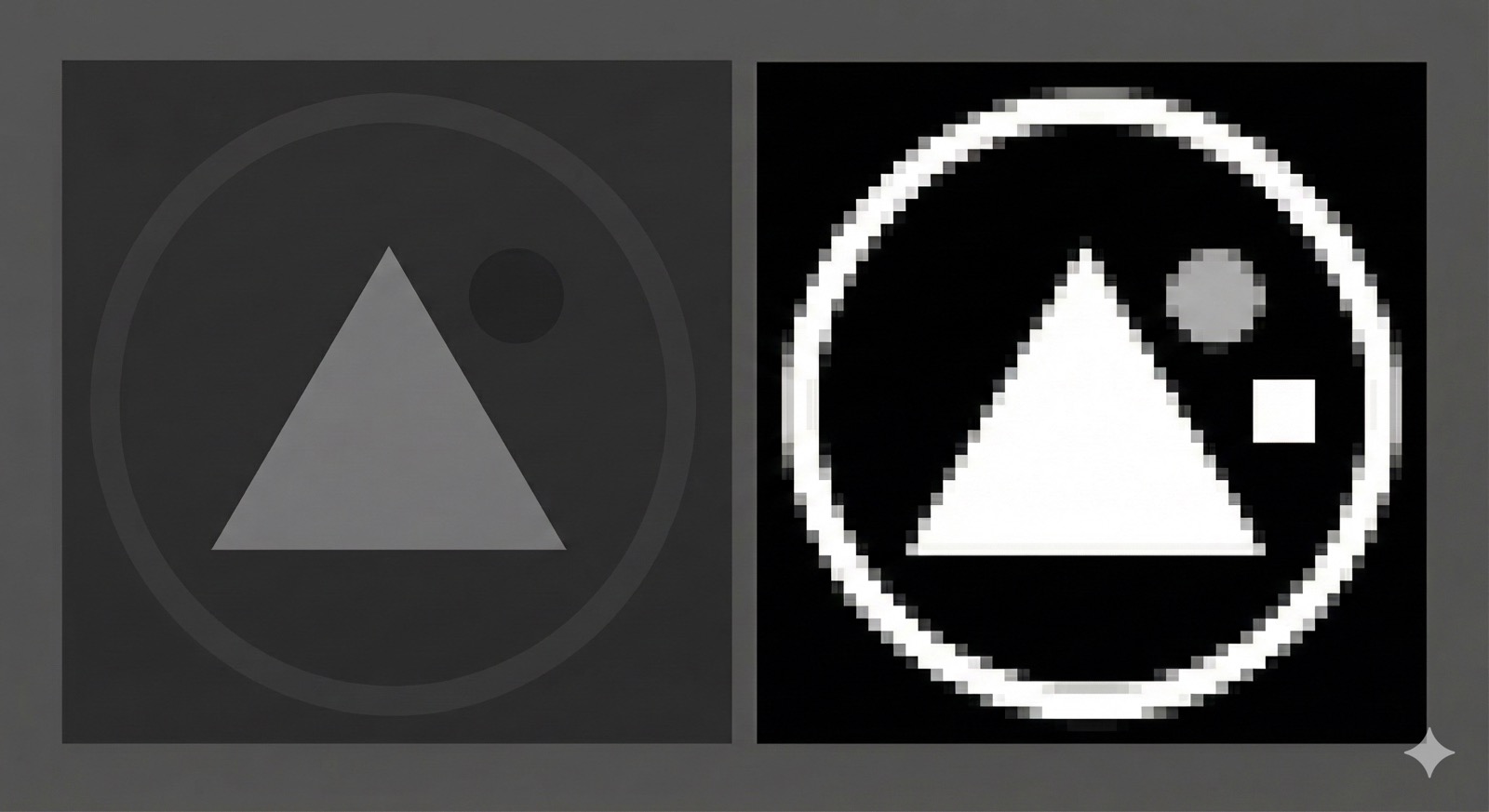
As a very crude example, here is one very high resolution crisp image, and another lower resolution but with a better contrast:
In the right hand image, we can see the small circle much more easily, plus the small square that has not appeared in the left image at all. If these structures represent parts of your brain, which gives more medical information?
How contrasts are generated
For most radiology modalities, the contrast mechanism is relatively simple. (N.B. I’m only talking about physical mechanisms, and not by any means saying the interpretation of images is necessarily straightforward…)
Ultrasound sends off mechanical waves and detect echoes reflected from tissues and tissue boundaries. Doppler ultrasound uses Doppler effect to detect flow rate. X-ray sends off ionising X-ray beams and detects how much is absorbed. Denser tissue typically absorbs more. CT is essentially hundreds of X-ray images stacked together to reconstruct a 3D model of the tissues.
MRI contrast is based on nuclear spin
The full name of MRI is (nuclear) magnetic resonance imaging. The nuclear bit apparently caused confusion among the public with the nasty weapons, so instead of educating people, healthcare professionals decided that it is easier to remove the N from acronym.
But there is nothing mysterious about nuclear or MRI. Without going into the physics:
Nucleus is the core of an atom; atoms make up molecules and everything in our body. The nuclei of a certain type in our own body, when put in a very strong magnetic field, resonates when the machine sends a radio frequency wave. Subsequently, the machine detects the signal coming from these nuclei which then form images. Nuclear magnetic resonance imaging.
In >99% of clinical MRI, scans work on the hydrogen atom nucleus, or simply protons. Wherever there are hydrogen (H) atoms, there could be MRI signal. Water (H2O), sugar, fat, and most things organic.
In other words, the contrasts in MRI arise from any differences in the properties of H atoms in the body. Some examples:
- There is lots of blood, hence water, hence H, in the heart; but very little H in the lungs. They can be distinguished by simply comparing how many H atoms there are. This is called the proton density contrast.
- There is more H in water molecules in muscle tissue, but more H in fat molecules in fat tissues. They can be distinguished by tissue-specific properties such as relaxation times, or molecule-specific properties such as the chemical shift.
Most soft tissues are similarly dense, which limits the level of contrast available on X-ray and CT. But since their exact compositions are different, MRI can still clearly distinguish them. Therefore, proton MRI is the key imaging technique especially for soft tissues.
A single MRI machine can produce many contrasts
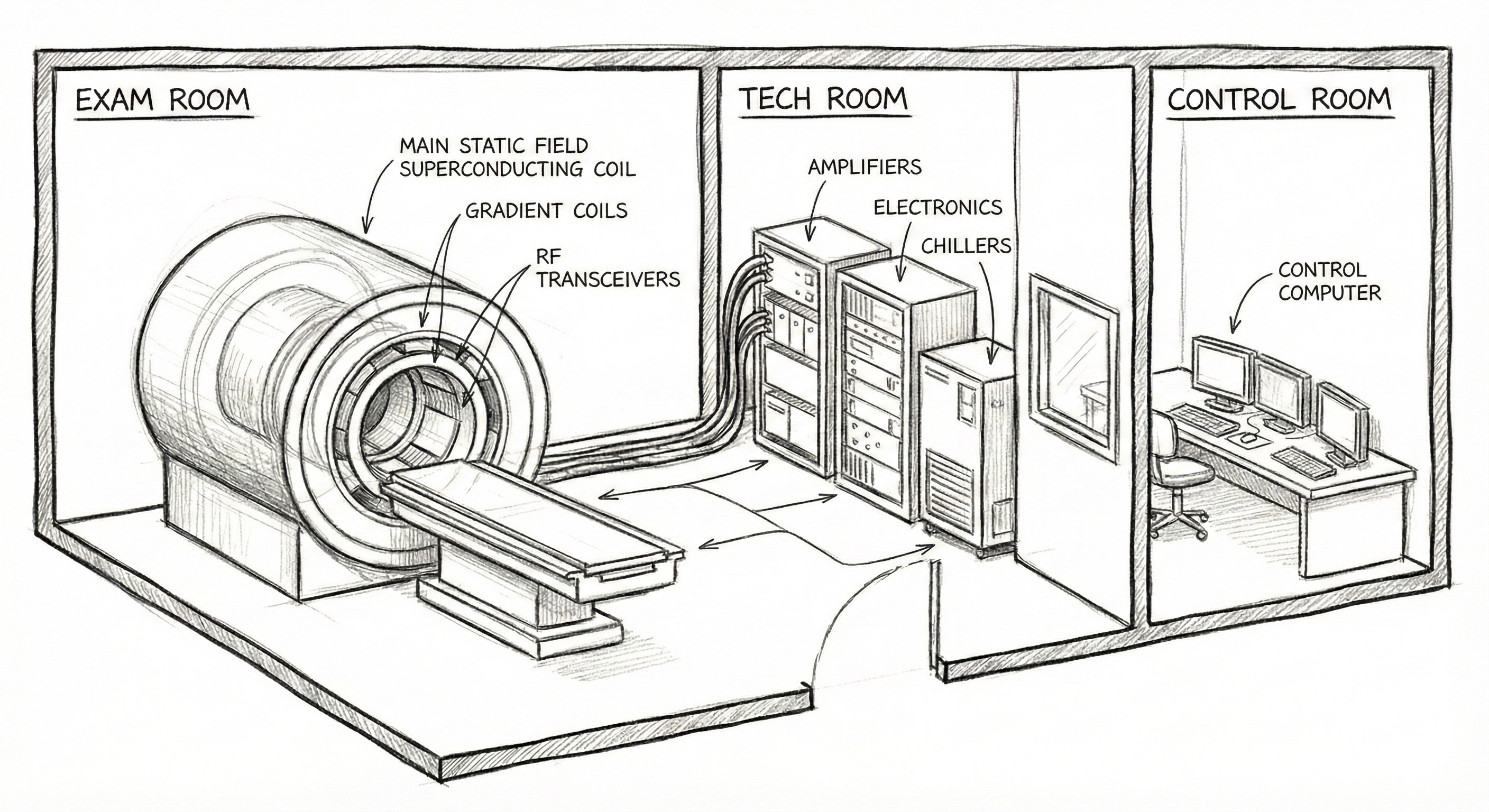
MRI machines typically consist of three key components in the exam room: a strong superconducting magnet to create the main static field, RF transmitter and receiver coils to excite nuclei and detect signals, and spatially-varying gradient field coils to achieve imaging. There are a lot more equipments in the tech room next door, including amplifiers for RF and gradients, and chillers to keep superconductors cool. Some systems (especially the trendy ultra-low field ones) use slightly different setups.
Almost always, a single MRI session involves taking multiple images of different contrasts. They are not achieved by processing the same signal in different ways, but instead, by actually generating and detecting different physical signals, on a single machine.
This is, in my opinion, the coolest feature of MRIs.
Modalities like X-ray (CT) and ultrasound sends a wave and detect it almost immediately. It’s like flashing a light or making a noise, where the recipient has to be there at that instant in order to see or hear. Apart from modifying the source wave and/or detector, there is very little room for manipulation.
MRI, on the other hand, is a two-step process. The machine first excites the nuclear spins (causing them to ‘dance in a spiral’), and then detects how the nuclei is spinning. It is like a relay. But the nuclei forget very quickly, so the detectable signal keeps decaying. In between, there can be anything between sub-milliseconds to a few seconds of gap, where the machine can do something else to manipulate the signal, making them more or less sensitive to different properties. Examples include diffusion, flow or even elasticity.
The implementation of these actions are called pulse sequences. Many pulse sequences have been developed to utilises the same set of hardware (RF source and gradient coils) generate different contrasts, making MRI extremely versatile.
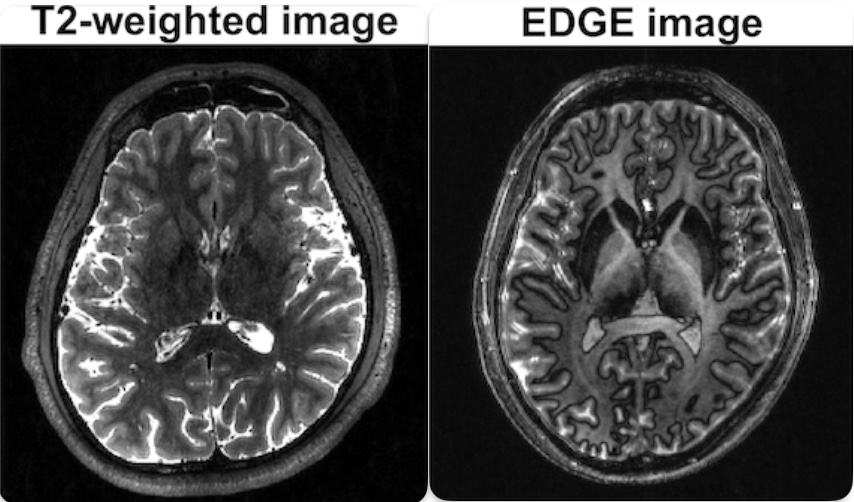
Here are two very distinct contrasts that I took on a volunteer.
Summary
- Doctors look for useful contrasts in medical images.
- The contrast of MRI is based on the hydrogen (or less often another type of) nuclear properties inside the body.
- The same MRI machine can produce multiple different contrasts.
- One main strength of proton MRI is its contrasts in soft tissues. This makes it suitable for diagnosing in soft tissues such as brains and tendons.